


A series where we take a #lookback at the stories and history of our community, brought to you by Mick Pryor, Financial Advisor with Edward Jones.
On April 6, 1917, the United States formally entered World War I. All efforts at home focused on winning the war. In 1918, Riverton passed an ordinance that required all able bodied men and women to be usefully employed for the war effort. Enlisting was patriotic, and those who didn’t were expected to support the effort by either working in wartime industries, or by purchasing war bonds to fund the military. Efforts were made locally in Riverton as well to raise financial support for the war. On July 14, 1917, at 2:30pm, the town of Riverton played a baseball game to help raise funds for the Red Cross in order to support the troops. But this wasn’t just a normal baseball game. This was the greatest game played in the 119 year history of Riverton.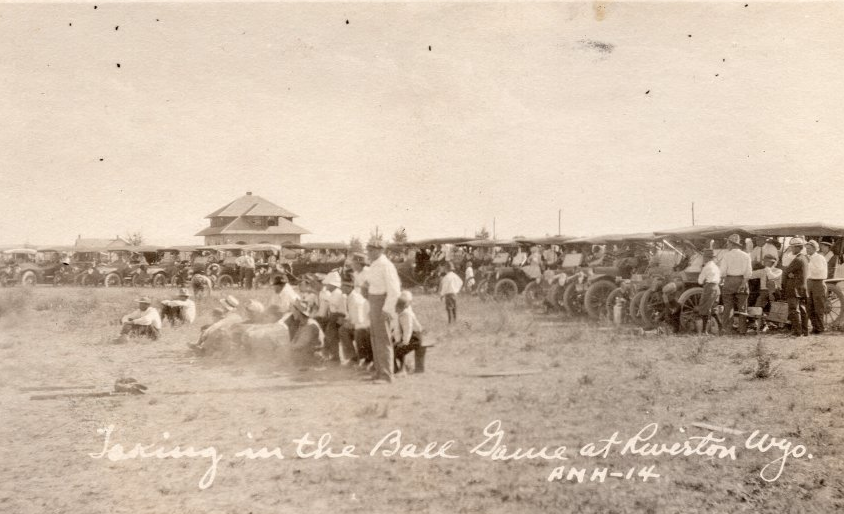
People Watching a Baseball Game in Riverton, Wyoming; No Date.
Of course, only eighteen men played in the ball game, nine per side. Though no mention is given on the total cost of admission price, the ball game earned, and donated, roughly $60.00 to the Red Cross, valued around $1,500 today. Many of these eighteen ball players were not just among the original settlers of the town, but some of the most influential figures in Riverton’s history. The story of Riverton’s “Greatest Game” is not only the circumstances around the game, nor is it the prominent cast. Instead, it’s about how the two teams were divided for the game: the “fats” vs. the “leans” of Riverton.
For the Fat Men, the lineup was as follows
J. H. Norris
Dr. Albert Benjamin Tonkin
W. J. McLaughlin
P. J. Cain
Fred Stratton
W. H. Lashbaugh
George Lawrence
Arthur Lawrence
W. J. Fazon
Business Manager: W. T. Judkins
Hitting second for the “heavy hitters” was Dr. A. B. Tonkin who needs little introduction. Riverton’s first or second (disputed) mayor, a councilman, school board clerk, and physician. He was also the first president of the Wyoming Health Officer’s statewide association, and a Lieutenant-Colonel in the Wyoming National Guard medical corps, the oldest serving member in the state, having served in the Spanish-American, Philippine, and both World Wars.
Behind Tonkin was W. J. McLaughlin, an early settler of Riverton. An oilman and road supervisor, W. J. “Billy Mac” McLaughlin was most known for his role in the Riverton railroad tie industry. In June, 1913, McLaughlin created the Wind River Timber Company in order to supply the Chicago and North Western Railroad Company with 500,000 ties annually. He was responsible for floating the ties down the Wind River from Dubois to Riverton where the tie treatment plant was being built. The efforts of McLaughlin helped make Riverton a key location for the Chicago and North Western railroad.
In the cleanup spot was one of the fan favorites and celebrities of the town: Pat J. Cain. Pat was one of the road contractors for the city of Riverton, along with his son. While his name might not carry the same weight today as “Tonkin” or “Delfelder,” the papers made it clear that he was the one to watch. He must have not only been one good ball player, but apparently quite the showman as well. The Riverton Chronicle, one of the two newspapers who reported on the game, writes “P(h)at Cain appeared to be the leading attraction for the corpulent and the batter’s box had to be enlarged to accommodate him.” Hitting fourth for a team consisting of the “larger-than-life characters” of Riverton not only attests to his skill as a ball player, but also to his size.
Slugging after Pat Cain was another key figure of Riverton’s history whose nickname leaves no doubt as to which team he would be playing for: Fred “Fat” Stratton. Fred D. Stratton was not just a founding member of Riverton who helped survey the original townsite, but he was a local politician and operated a hardware store for decades. Fred served as a director of the local bank, was appointed to the first council of Riverton, and was one of the original Board of Trustees members. He operated the Stratton Hardware store with his family, before selling it to Hoffman Electric in 1930. In 1969, before Hoffman replaced it with a much needed modern building, the old Stratton Hardware store was the oldest remaining building in Riverton.
Riverton’s final famous fat figurehead was the manager, William T. Judkins. He moved with his family to Riverton following the opening of the reservation from Basin, Wyoming, in a covered wagon. In 1909 he was appointed as an agent of the Bureau of Animal Industry. His main claim to fame was that he was the first postmaster in Riverton, while his son, Lincoln Judkins, was the first mail carrier.
The Lean Aggregation lineup was as follows:
Dr. John G. Cogswell
O. T. Jordan
Ira J. Burleson
Roy A. Fairbanks
Harry Megown
E. T. Glenn
Jacob Ritterbush
J. A. Delfelder
J. H. Arnold
The first player we have information on among the aptly described “skinny ginks” was O. T. Jordan. Jordan was, like so many of the other players, among the first wave of homesteaders that arrived in 1906. He came as a farmer and feeder from Illinois, and was well liked in the early days of Riverton as he was the supplyman for many of the homesteaders, traveling into town whenever required. He also was the first Riverton resident to ship lambs out from town, having built feedlots immediately after arriving in Riverton.
Third in the lineup was Ira J. Burleson, the owner of the Burleson drug store. Burelson, a pharmacist who had worked previously in Omaha and other large cities, made a deal with Dr. Tonkin to build a drug store. Tonkin would build the brick building, and Burleson would install a modern drug store. Burleson Drug, which opened in December 1915, became a popular spot in Riverton for its quality malts and sodas. Three generations of Burelson’s worked in the store before it finally closed, and when it did, they donated many of their goods to the Riverton Museum where many of their objects are still on display.
In the six-hole was E. T. Glenn. Glenn was born on February 17, 1871, and when he moved to Riverton in 1906, he became Riverton’s first merchant and built the first local supermarket. Before he had his actual building, he sold sugar, flour, canned milk, salt, tobacco, and other goods from the back of his wagon. When the town was settled, he set up a large tent which served as both his home and his house where he then operated out of. His store opened shortly after, but was forced to close in 1929 with the beginning of the Great Depression. Glenn also served on the first town council, was one of the first county commissioners, was on the first school board, and was responsible for many of the bridges and roads in town getting built.
Hitting seventh was Jacob Ritterbush, the owner of Ritterbush Bargain Store, where he sold groceries, shoes, and clothing. He was a real businessman and in addition to his store, also had interests in the cattle industry. In 1915, he sold a half interest in his store to a Mr. Woodring from Missouri in exchange for a large chunk of land and a home back in Missouri. An interesting story from his life is that, following the death of his first wife, he remarried a Mrs. Martha Haskins and filed for marriage papers on the same day that his son, Fred Ritterbush, married Miss Mary Bray, the daughter of the same Mrs. Martha Haskins.
Finally, the most famous of the lean ballplayers was J. A. Delfelder. Though unquestionably a great man, being listed so far down the lineup suggests he was not so great a hitter. Jacob Astor Delfelder was a mayor of Riverton for many years. Born on a farm in Kansas in 1871, he moved to Wyoming in 1892 where he worked in the cattle and sheep industry for years. He moved to Riverton in 1913 where he quickly made an impression as he was elected mayor in 1914 without opposition. By this time, he had 50,000 sheep, around 2000 cattle, 500 horses, and owned hundreds of acres of grazing property. He was President of the Wyoming Wool Growers’ Association from 1905-1914, was Vice President of the western National Wool Growers Association in 1908-1909, and served in the Wyoming House of Representatives in 1915-1917. Though his stock took quite a hit in the harsh winters of 1919, following his death in 1921, the shares of his sheep company were still sold for roughly $2.5 million in today’s money.
Though this was a game for charity, trash-talking began before the game started in the papers. Pat Cain, the largest player in the game, spent the days before bragging about his speed. In the papers he claimed he would “show Dynamite Kile how to steal bases in a manner that will make the autopolo players ‘stunts look like tame sport.” Dynamite Kile was one of the better athletes in early Riverton who was fighting in France during World War I, and won the city’s 100 yard dash in 1911.
Though Vegas didn’t set any odds, the bigger boys were favored to win according to the Riverton Chronicle. Unfortunately, we don’t have the box score of the game, but we are left with a colorful conclusion of the game. “Some of the thin men were too weak to stand the steady strain of the contest and rested occasionally, while the fats had to lay off once in a while after making a hard run. The result of the game was a score of 12 to 15 in favor of the fat men, and that score, and how it happened, is still being discussed at considerable length by some of those who participated in the game.” Before the game, both sides agreed to play a five inning game. However, by the end of the fifth, seeing as they were losing, the lean team believed they would win if they played a full nine innings, thinking they could outpace and outlast their counterparts. There was also plenty of complaining about Frank E. LaMar and E. S. Gilberts, the umpires for the match. Following the game, Roy Fairbanks, one of the skinny players, claimed that “the leans can trim the fats for money, chalk or marbles any old day, and he is anxious to play again on the condition that the losing team donate the sum of $1,000 to the Red Cross.” Always the center of attention, Pat Cain replied it was beneath his dignity as a ball player to cross bats with the “slim fellows for less than a $5,000 purse for the Red Cross Society.”
We are also given three highlights from the ball game. “J. A. Delfelder happened in the path of E. T. Glenn on one occasion, and E. T. removed him in a very unceremonious manner.” How this happened is unclear as they were on the same team, but most likely collided in the field. We are also told that “Pat Cain, the fattest of the fats, made three scores,” and upheld his reputation as one of the best players in town. The final statistic we are given is not so much a statistic than a series of unfortunate events. J. H. Norris, in an effort to create his own version of the Gordie Howe hat trick, in one inning managed to break his bat, tear his pants, and step on a nail by the time he reached home plate.
Though a $1,000 or $5,000 money re-match was hinted to come in the following week, we would have to wait another year to see the two sides take the field again. One June 2, 1918, the heavy-weight grudge match resumed, albeit with a significantly less star-studded lineup.
Fat Men:
“Thompsonfi Boland”
Saxon
Keating
Kirch
Cain*
Holmberg
Garrettson
Fowler
Van Ness
Lean Men:
Dr. John G. Cogswell*
Fowler
Brenniman
Collins
Fairbanks*
Wilcox
Dobler
Littlefield
Miller
*asterisked names played in the 1917 game
“Thompsonfi Boland” most likely refers to two separate players and Riverton community members: F. L. Thompson and one of the members of the also prominent Boland family. However, if they were two separate players for this game, the lineup for the “big boys” would have ten total players.
This game was, like the previous, a fundraiser for the Red Cross. While no admission was charged, they were accepting donations at the field and raised $58.31, a nearly identical total to the year before. Most likely due to the “heavy” turnover among the fat men, the second iteration of the “skinny ginks” managed to pull out a win. The final scores differ between the Riverton Review who claimed a 17-11 victory, and the Riverton Chronicle who reported a 19-11 scoreline.
Unfortunately, it seemed that while both papers attempted to report the scores of the game, neither managed to send a reporter to the game for any details. The only description we are given is that Pat Cain was again present and was “as usual the feature. [Pat] had been in left field but the manager had to put himself on third before he run himself ragged.”
On June 28, 1919, the Treaty of Versailles put an end to hostilities and World War I. Though it brought an end to the fighting, the signing of the treaty caused one more casualty; with the war over, the seemingly annual fat vs skinny ball game was no longer needed to raise money for the Red Cross. Those who put an end to the war failed to consider the greater consequences of their actions: the fat vs skinny series would forever remain tied 1-1.
Thankfully, we were treated to the tiebreaker game. A full decade after the first game, in mid-August, 1927, the final Fat vs Lean baseball game was played. No details for the game are given outside the lineups before the game.
Fats: Captained by Bill Madden
P. T. Myers
Jack Perrin
Charles Brooks
J. H. Dalton
Charles Fall
F. M. Fry
Frank Holt
Frank Clark
Abbot Hastings
Leans: Captained by Dr. Walter Warren
A O. Hurst
D. C. Hay
Jess Gardner
Roy McFarlane
Grover
Stephens Jim Harris
Ben Cochrane
E. F. Piper
John Piggott
Though we have no details to the game, we are given the winner of the game, and therefore the series. When the stakes couldn’t get any higher, the final score was: Fat 6 – Skinny 5.
Author: Kevin Scannell, Riverton Museum
Next up for the Fremont County Museum
March 29, 1-3pm at the Pioneer Museum, “Celebrating Women’s History Month” Wyoming Community Bank Discovery Speakers Series
April 19, 1-3pm at the Pioneer Museum, “Sheep Shearing Day” Bailey Tire/Pit Stop Children’s Exploration Series
April 26, 9-2 with the Pioneer Museum, “Garden Expo Craft Booth” Bailey Tire/Pit Stop Children’s Exploration Series
May 22, 7pm at the Pioneer Museum, “Lander 1925” Wyoming Community Bank Discovery Speakers Series
May 24, 1-3pm at the Pioneer Museum, “Being a Pioneer Kid” Bailey Tire/Pit Stop Children’s Exploration Series
May 24, 10am at the Pioneer Museum, “Lander Main Street Trek” Wind River Visitors Council Adventure Trek Series
May 31, 11am at the Riverton Museum, “Horned Owl Draper Raptor Experience” Bailey Tire/Pit Stop Children’s Exploration Series
Call the Dubois Museum 1-307-455-2284, the Pioneer Museum 1-307-332-3339 or the Riverton Museum 1-307-856-2665 for detail regarding their programs.
The Dubois Museum, the Pioneer Museum in Lander and the Riverton Museum need your financial support. In the current economic environment, the museums are more reliant than ever on donations from the private sector to continue to provide the quality programs, collections management, exhibits and services that have become their hallmark over the last four years. Please make your tax deductible contribution to be used specifically for the benefit of the museum of your choosing by sending a check to Fremont County Museums 450 N 2nd Rm 320 or taking it directly to the museum you choose to support, or log onto www.windriverccf.com to make your donation to the foundation that supports our museums.